



Look at the aluminum die casting industry trends in 2020
2020-10-18 Browse: 2527 Author:
In recent years, Chinas die-casting products are diversified, including automobiles, motorcycles, communications, home appliances, hardware products, power tools, IT, lighting, escalator steps, toy lights, etc. Cars and motorcycles account for 542,700 tons, or 62.8%, in the total volume of die-casting parts in China. 138,200 tons of hardware toys, accounting for 16%; 101,900 tons of electrical and electronics, accounting for 11.8%; Other areas 81,400 tons, accounting for 9.4 percent. During the eleventh Five-Year Plan period, by increasing investment in scientific research, closing down backward production capacity, and promoting mergers and acquisitions, the optimization and upgrading of the foundry industry structure achieved remarkable results, the industrial concentration increased, and a number of top 100 and pioneer enterprises with advanced technology, management and quality emerged.
In 2014, the national output of die casting was 3.0642 million tons, and in 2015, the total output was about 3.7 million tons, still maintaining a stable growth compared with 2014. In Chinas existing die-casting enterprises, the annual growth rate of die-casting output remains above 20%, and aluminum alloy die-casting output accounts for more than 3/4 of all die-casting output. Due to the internal optimization and upgrading of the automobile industry in recent years, aluminum alloy castings are gradually replacing gray iron castings, which continuously stimulates the growth of the demand for aluminum alloy die castings. Especially driven by the trend of automobile lightweight, the global aluminum alloy die casting market has been a huge demand. In the 21st century, Chinas magnesium industry has developed rapidly and become the largest magnesium producer and exporter in the world. Whether mobile phone, computer shell, automobile steering wheel, gearbox housing, central control support, seat, and aerospace materials, magnesium and magnesium alloy products have rapidly entered peoples lives, and become one of the most valuable development and application prospects of the emerging strategic non-ferrous metals.
In the research and development of die casting technology, the deepening of aluminum alloy die casting will still be a main direction of die casting technology development. The first is to promote the application of the new type of high strength, high wear resistance die casting alloy, research on coldable die casting alloy and for casting with special safety requirements; The second is to develop die-cast aluminum alloy with stable performance and easy composition control. The third is to simplify the alloy composition, reduce the alloy brand, to provide the basis for green production; The fourth is to develop and apply more die-casting aluminum alloy auto parts.
In 2015, Chinas die casting industry was struggling to move forward, with bottoming aluminum price, overcapacity, disordered competition and little profit. However, there are many highlights, such as improving the die-casting technology level, following the trend of lightweight automobiles, semi-solid aluminum alloy industrial application, and new energy automobile die-casting support, which add endless confidence and strength to Chinas die-casting industry in 2016.
In addition, China ranks the first in terms of magnesium resources in the world, and the development of magnesium alloy is helpful to alleviate the resource crisis of traditional metal minerals in China. The application of magnesium alloy in the civil field is of great strategic significance to alleviate energy crisis, reduce pollution and especially improve the competitiveness of "Made in China".
2. Industry positioning
The companys products are mainly divided into communication equipment and auto parts (including electric equipment, LED lights, etc.). Communication equipment is mainly die-casting parts and accessories of various parts of base station, and the products are mainly used in mobile base station and other aspects. The market is mainly oriented to Europe and India, distributed in the United States, India, Poland, the Netherlands, Slovakia, etc., and the main downstream customers are Nokia Siemens, Sihai Electronics, Foxconn, etc. Automotive products are mainly used in the whole series of vehicles (transmission, engine, etc.), the market is mainly oriented to Europe and domestic, the main customers are SAPA, OMS, Nanjing Bofeng electric, Mariley and so on.
(1) Base station
I) Communication base station market
Base station, namely public mobile communication base station, is a form of radio station. It refers to a radio transceiver station that transmits information between mobile communication exchange center and mobile phone terminal in a certain radio coverage area. As one of the core devices to realize mobile communication network coverage, base station is an important part of mobile communication system. With the development of mobile communication network service to the direction of data and grouping, the development trend of mobile communication base station is bound to be broadband, large coverage and IP. The choice of a base station should be considered comprehensively from the aspects of performance, matching, compatibility and use requirements, among which special attention should be paid to the fact that the base station equipment must be compatible or matching with the mobile switching center, so as to achieve a better communication effect.
Base station has achieved rapid development with the progress of mobile communication industry, and will continue to maintain rapid growth for a long time in the future. In developed countries, with the popularization of 3G and mobile broadband access and the growth of smart phones, netbooks and portable laptops, more frequencies will be used for 3G and mobile broadband access services, and developed countries need to continue to increase the capacity of communication networks. At the same time, emerging markets in Asia countries such as India, Pakistan, Indonesia and parts of Africa, Latin America and other regions of the country, is at the stage of how to build a large-scale mobile communication network, network optimization and upgrade is a trend in the development of their future, and to the development of mobile communication equipment industry has provided a broad market space. All these will promote the global communication market to maintain a relatively high growth rate for a long time in the future, and also guarantee the market demand and continuous growth of the base station equipment industry. With the development of global 3G and 4G networks, as well as the promotion of LTE and the application of MOMO technology, base station equipment will gradually increase. In 2013, the global telecommunications equipment market reached $74.58 billion. (The figure below takes the increase of base station antenna as an example)
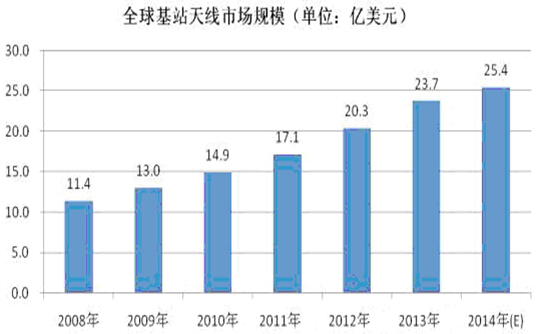
With the "exponential" growth of Internet traffic, the overall demand for 4G network construction in China has not changed. The number of 4G users of China Mobile, the leader in 4G network construction, continued to grow substantially, reaching nearly 380 million in total in 2015. Li Huizi, vice President of China Mobile Group, said that China Mobile has completed the construction of more than 1 million 4G base stations so far, and the third phase of the construction has been completed, realizing the continuous coverage of 4G counties and towns, and the breadth and thickness are also constantly improving. In 2016, China Mobile will vigorously develop 4G users and build more than 300,000 4G base stations. The NUMBER of 4G users will exceed 500 million by the end of 2016.
Ii) Nokia Siemens networks
In June 2006, Nokia and Siemens jointly announced the merger of their telecoms equipment businesses, creating Nokia Siemens Networks with a 50-50 split in a €25bn deal. In April 2007, NSN was officially put into operation. On the evening of November 23, 2011, NOKIA Siemens announced that it would cut 17,000 jobs worldwide by the end of 2013. On July 1, 2013, Nokia announced that it would pay 1.7 billion euros (about 2.2 billion DOLLARS) for the full acquisition of Siemens 50% stake in Nokia Siemens Networks (NSN). Nokia Siemens will change its name to Nokia Solutions and Networks and continue to use the NSN name in its business.
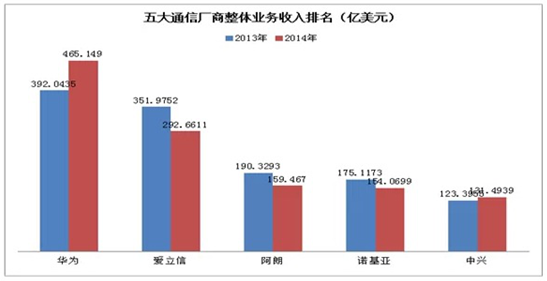
The last wave of mergers in the telecoms equipment industry took place a decade ago, giving rise to Alcatel-Lucent and Nokia Siemens Networks. As the two companies have been busy integrating their businesses, their market share and market value have plummeted as competitors have been aggressively pushing into the market. In 2009, Ericsson bought Nortel to take over the North American market. Since 2011, the ranking of Ericsson, Huawei, Alang, NSN and ZTE has been fine-tuning. In 2013, Alang decided on the strategy of transformation: focusing on IP, cloud and uWB access. In September 2013 Nokia sold its handset business and paid down debt, focusing on the network, HERE maps and technology. Its core business is networking, which accounts for about 90 per cent of Nokias total revenues.
According to the revenue scale of the top five equipment manufacturers in 2014: Huawei, Ericsson, Aland, Nokia, AND ZTE. According to nokias SEC filing, nokia had net sales of 12.7 billion euros in 2014. The market was mainly in Europe, accounting for 31%, followed by Asia-Pacific, accounting for 26% and The Americas, accounting for only 15%.
Arno merger: On April 15, 2015, Finnish telecom network equipment maker Nokia agreed to acquire French rival Alcatel-Lucent for 15.6 billion euros ($17.4 billion); On August 28, 2016, nokia, Shanghai bell, alcatel lucents flagship company of China), huaxin post economic development center of China (hereinafter referred to as "China huaxin") three successively release, nokia huaxin signed the memorandum of understanding with China, to confirm their intends to set up a new joint venture, and nokia China telecom equipment business (" nokia China ") and Shanghai bell to integrate into the new joint venture. On September 22, 2016, Nokia made a public offer to acquire the remaining shares of Aron at 3.50 euros per share. The convertible bonds due in 2019 and 2020 will be worth 4.51 euros and 4.50 euros respectively.
Aron has 52,000 employees worldwide. Nokia employs nearly 62,000 people. The new company will use the Nokia brand, but will retain Mr Arrans Bell LABS for its research and development activities. Nokias acquisition of Aland was a "coalition of the weak", creating a global network equipment giant capable of rivaling Swedens Ericsson and Chinas Huawei in terms of revenue. With complementary operations in Europe, it makes sense for the two companies to merge, and the expansion will help them cut costs. At the same time, Nokia will expand its presence in the crucial U.S. market, where Arron is a major supplier to Verizon and AT&T, the largest U.S. carriers. In the wireless field, Arons main battlefields are distributed in North America, Asia-Pacific and Europe, while Nokias revenue mainly comes from Europe, Africa and the Middle East, and the two markets have been fully expanded. At the same time, The optical network and IP business of Arun can realize the "full service" transformation of Nokia, which is more conducive to Nokias layout in 5G and cloud computing fields.
(2) Automobiles and parts
According to the "2015-2020 China Die-casting Industry Market Foresight and Investment Strategic Planning Analysis Report" released by Foresight Industry Research Institute, the national automobile output in the first half of 2014 was 4.630,300, with a year-on-year growth of 28.94%. Sales reached 4.53552 million units, up 26.71 percent year on year. Exports of automobiles and parts rose 44.32% to $11.327 billion in the first half from a year earlier, the General Administration of Customs said. GDP is expected to grow by 8% in 2015, compared with real growth of 10.9% in the first half of the year. From January to September in 2015, Chinas total automobile production fell by 0.8% year-on-year and sales volume increased by 0.3% year-on-year, basically in the trend of zero growth. The growth rate dropped by 8.9 and 6.7 percentage points respectively compared with the same period of last year. Die casting industry will continue to maintain steady development.
3. National policies and fiscal and tax policies of relevant industries.
(1) Die casting industry
Application of lightweight Materials for Automobiles: High-strength steel, aluminum-magnesium alloy, composite plastics, powder metallurgy, high-strength composite fiber, etc., will be included in the Guidance Catalogue for Industrial Structure Adjustment (2011). "Transportation, high-end manufacturing and other fields of non-ferrous metal new material production. ... New types of high-strength, high-toughness, corrosion-resistant aluminum alloy and large-size products for the main load-bearing structures of transportation vehicles..." ", "high precision hydraulic casting (runner dimension accuracy ≤0.25 mm, fatigue performance test ≥2 million times)" and other relevant items related to the issuer are listed as the state encourages the development of the industry.
"Foreign Investment Industry Guidance Catalogue (Revised in 2011)", "High-tech non-ferrous Material Production:... Magnesium alloy castings,...... Magnesium alloy and its application products "; "Automobile and motorcycle lightweight and environmentally friendly new material manufacturing (body aluminum, aluminum, magnesium alloy materials, motorcycle aluminum frame, etc.)" and other items are encouraged products.
The Measures for the Administration of The Recognition of New and High Technology Enterprises lists the production of high performance aluminum alloy, magnesium alloy materials and castings by precision die casting technology as a new and high technology field supported by the state.
(2) Communication base station
Chinas broadband strategy, 4G mobile network scale construction (future 5G), mobile resale and access network market opening, the establishment of Tower Company, Internet +, industrial Internet and the recently proposed acceleration and fee reduction, etc., a series of major events and technological evolution are expected to push the communication industry chain into a new round of prosperity.
For implementation of the "broadband China" strategy and implementation plan "(guo fa [2013] 31), vigorously promote information consumption, accelerate the two fusion depth and hand in hand with the development of modernization, the comprehensive construction network power and support the construction of manufacturing powerhouse, now is the implementation of" broadband China "2015 special action put forward the following opinions: jump broadband network capacity. An additional 80 million households will be covered by optical fiber, and a number of cities will become all-optical network cities for the first time. More than 600,000 NEW 4G base stations will be built, covering counties and developed towns. An additional 14,000 administrative villages will have broadband access. The scale of popularization and the speed of broadband Internet continue to improve. The number of broadband users with access rates of 8Mbps or above accounts for 55%. We will encourage areas where conditions permit to promote high-bandwidth access services such as 50Mbps and 100Mbps, so as to continuously improve users Internet experience. Actively support and serve intelligent manufacturing. We will support 100 industrial enterprises above the designated size to actively explore new models and business forms of smart factories, smart equipment, and smart services, support 1,000 industrial and production service enterprises in providing high-bandwidth dedicated lines of service, increase the number of M2M (machine communication) terminals by 10 million, and promote the development of the industrial Internet.
On May 13, 2015, the General Affairs Council of the State Council made arrangements to speed up the construction of high-speed broadband network, promote speed up and reduce fees, help entrepreneurship and innovation and improve peoples livelihood, including the decision to speed up the construction of high-speed broadband network; (Encourage telecom enterprises to issue speed-raising and fee-lowering schemes, increase the average urban broadband access rate by more than 40%, and reduce the tariff level); Promote fiber to the home and broadband rural projects; We will promote open and fair competition in the telecommunications market (introducing services such as traffic non-zero and traffic transfer). The number of pilot enterprises to open broadband access services increased to more than 100 during the year. We will provide strong support for the "Internet Plus" initiative, boost effective investment and consumption, and foster new drivers of development. And broadband acceleration will further drive the demand for Internet infrastructure.
 Return
- 0576-82881000
- 0576-82868000
- tztx1000@126.com
- Jinqing Town, Luqiao District, Taizhou City, Zhejiang Province



COPYRIGHT © Zhejiang Taixing Electromechanical Technology Co., Ltd ALL RIGHTS RESERVED